
What the three options mean
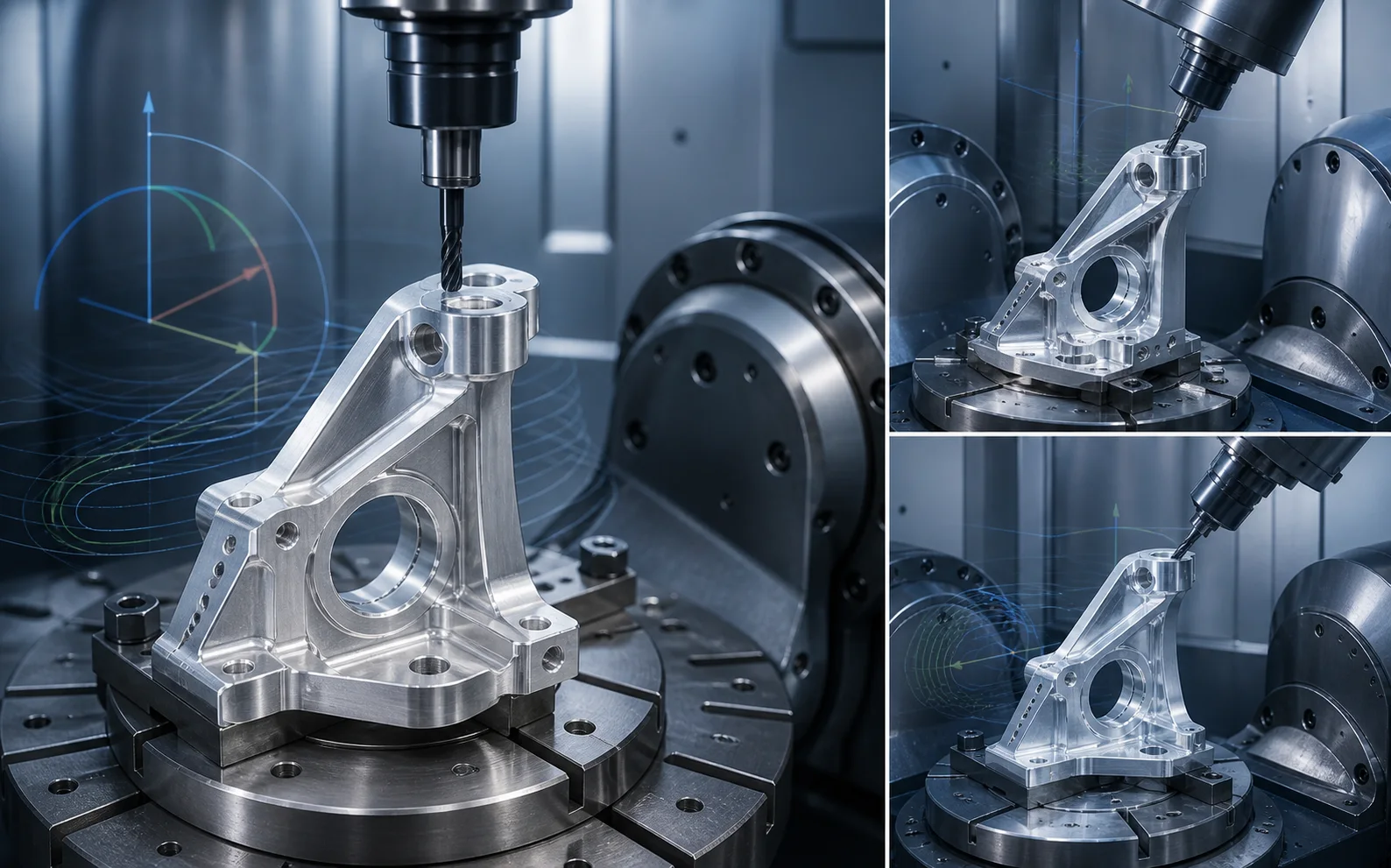
A 3-axis mill moves along X, Y and Z and handles most faces, holes, slots and common pockets. A 4-axis machine adds one rotary axis for circumferential or multi-side work. A 5-axis machine adds another rotary degree of freedom so the tool can approach from more directions.
Five-axis work may be positional 3+2 machining, where rotary axes index and lock before a 3-axis cut, or simultaneous 5-axis machining, where several axes move during cutting. The latter is useful for blades, complex surfaces and continuously changing tool angles.
Count approach directions before counting axes
Mark the direction from which every hole, pocket and contour must be reached. A part dominated by one direction is usually a 3-axis candidate. Circumferential or repeated side features may suit a 4th axis. Several angled features, deep cavities or continuously changing surfaces justify a closer 5-axis review.
Then connect the critical dimensions. Two holes may be easy individually but difficult as a pair when their axes come from different directions and their positional relationship is tight. The value of extra axes is often preserving one reliable coordinate relationship, not merely reaching the metal.
- Map cutting directions and likely toolholder, spindle and fixture interference.
- Identify critical dimensions and GD&T spanning different faces.
- Check whether a repeatable datum remains after every planned flip.
When 3-axis is the better choice
For mostly orthogonal faces, holes, slots and simple pockets, 3-axis work is often easier to program, widely available and economical. If one or two reliable setups preserve the critical relationships, specifying 5-axis adds cost without adding value.
Standard vises, clamps and soft jaws are straightforward to deploy, prove out and transfer. For a stable production part, a dedicated fixture on a 3-axis machine can outperform a general-purpose 5-axis approach.
- Features are accessible from the top or a few fixed directions.
- Stable datums remain available after the part is flipped.
- Volume is limited and fixture and programming cost matter.
Four-axis machining works around one rotary line
The clearest 4-axis applications are shafts, rings, radial holes, repeated circumferential features and small housings that would otherwise be turned by hand several times. The rotary axis reduces handling and re-indication; it does not necessarily make the cut itself faster.
Check whether one rotary direction covers the important features. A second family of nonparallel angled holes may still require another setup or positional 5-axis machining. Chuck, tailstock and tool reach must also be included in the interference review.
- Indexed work rotates to a fixed angle and locks before cutting.
- Continuous rotary work coordinates rotation with linear motion.
- A fourth axis does not eliminate fixture or workholding constraints.
3+2 positioning is not simultaneous 5-axis cutting
In 3+2 machining, the two rotary axes orient the tool or part, lock, and then a 3-axis toolpath cuts from that direction. It is effective for multi-face pockets, angled faces and angled holes and is generally easier to program and prove out.
Simultaneous 5-axis changes tool orientation while cutting. It fits impellers, blades, sculpted dies and other geometry that requires continuous orientation. It also demands stronger CAM, post-processing, machine-kinematic validation and collision control. If the part only needs several fixed directions, 3+2 often captures most of the benefit.
The practical gains are shorter tools and fewer setups
A deep cavity on a 3-axis machine may force a long tool extension to clear the holder. The resulting loss of rigidity can increase vibration and force conservative cutting parameters. Tilting the tool can provide clearance with a shorter, stiffer assembly.
Completing related features in one setup can also reduce datum-transfer error. That does not make accuracy automatic: rotary-center calibration, thermal behavior, fixture stiffness and machine condition still matter.
Compare total part cost, not hourly machine rates
A 5-axis hourly rate may be higher, but the complete route includes programming, fixtures, setups, cutting, deburring, inspection and risk. A 3-axis route with three flips, two sets of soft jaws and repeated probing can cost more than a single positional setup. A simple part can show the opposite result when 5-axis preparation saves little.
Ask for the cost of a conforming part. Consider how non-recurring engineering is amortized, how unit cost changes with volume, how critical features are controlled and how much work must be repeated after a failure.
- Non-recurring: CAM, post validation, fixtures and first-piece prove-out.
- Recurring: cutting, tool changes, loading, deburring and inspection.
- Risk: setup error, collision, scrap material and schedule recovery.
Two simplified examples
An aluminum bracket with a top pocket and ordinary side holes may be cheapest on a 3-axis machine with two or three reliable setups. With volume, 4-axis indexing or a dedicated fixture may reduce labor. Add two tightly located angled holes relative to the center bore and positional 5-axis becomes more attractive.
A blisk with twisted blades, narrow passages and continuously changing tool vectors generally needs simultaneous 5-axis motion and full machine simulation. Capability then includes travels, kinematics, tooling, post processor and inspection—not merely a machine badge that says five axis.
Six questions to include in an RFQ
Send the 3D model, controlled 2D drawing, material, quantity, critical tolerances, finish and target date. Rather than dictating five axis, ask the supplier to explain the manufacturing assumptions.
- Which strategy—3-axis, 4-axis, 3+2 or simultaneous 5-axis—and why?
- How many setups and what primary datums are planned?
- Where are tool and fixture interference risks?
- Which critical relationships are completed in one setup?
- How will the first part and critical features be inspected?
- At what volume would a different fixture or machine strategy make sense?